
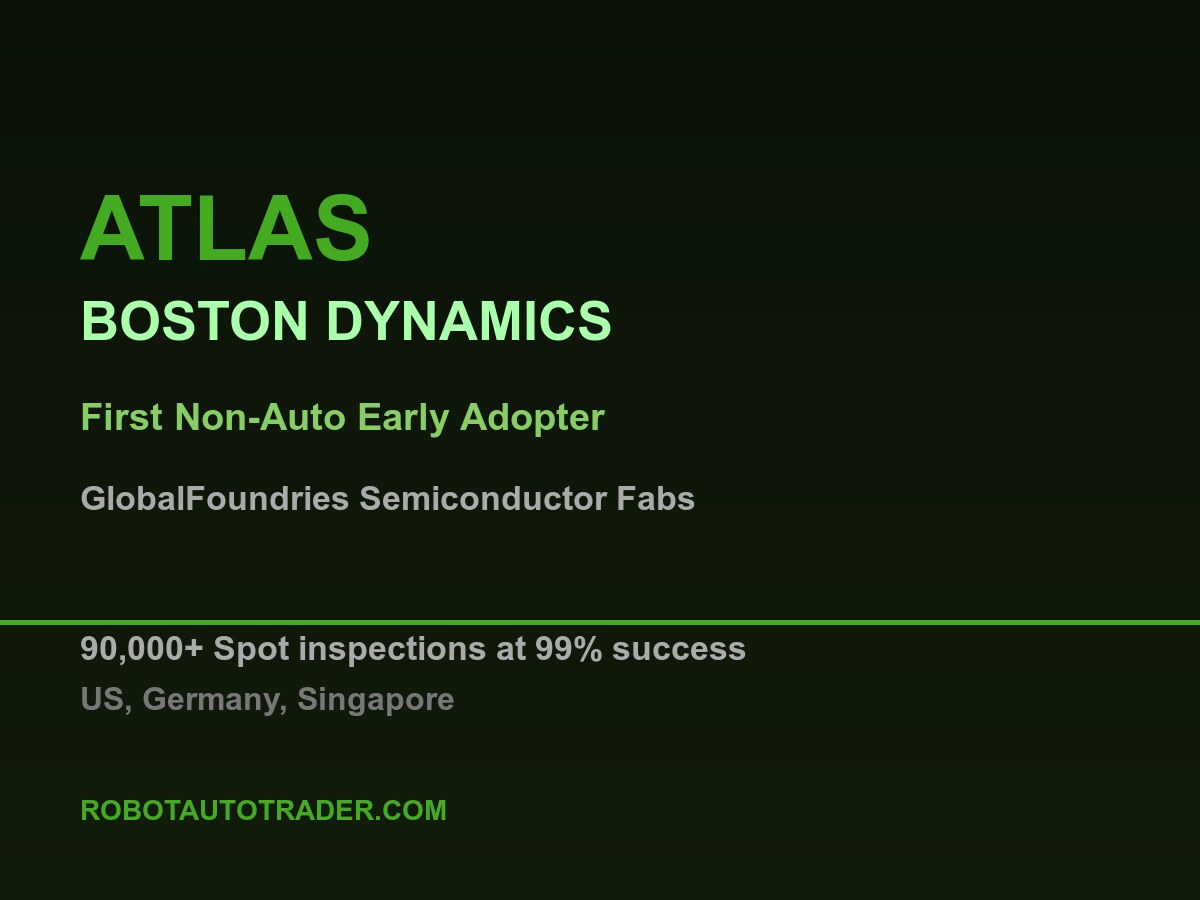
Boston Dynamics and GlobalFoundries made a quiet but significant announcement on 17 November 2026: GlobalFoundries, the US-headquartered contract chipmaker with manufacturing sites across three continents, has become the first company outside the automotive sector to join the Atlas early adopter programme. For the robotics industry, it marks a turning point. For buyers and sellers of used Boston Dynamics hardware, it carries a more immediate message about the platform they are trading.
> QuickAnswer: On 17 November 2026, Boston Dynamics announced GlobalFoundries as the first non-automotive member of the Atlas early adopter programme. Atlas trials at GF semiconductor fabs are planned for early 2027 and remain exploratory. Meanwhile, Spot robots already deployed at GF's Singapore facility have completed more than 90,000 inspections at a 99 percent mission success rate. The deal confirms Spot as a commercially proven inspection platform and strengthens the investment case for used Spot units in the UK secondary market. Used Spot Enterprise units currently trade between £35,000 and £55,000 on the UK market depending on configuration.
What Boston Dynamics and GlobalFoundries Announced
The 17 November announcement covers two distinct things, and it is worth keeping them separate. The first is an expansion of the existing Spot relationship. GlobalFoundries has been running Spot robots at its Singapore fab since April 2026 and is now extending those deployments to additional sites: Malta in New York, Burlington in Vermont, and Dresden in Germany. The Spot expansion is live and ongoing.
The second is the Atlas early adopter agreement. This is new, forward-looking, and explicitly framed as exploratory. Under the agreement, Boston Dynamics will work with GlobalFoundries to identify tasks a humanoid could perform in semiconductor manufacturing, establish requirements, and begin initial task testing and training. On-site Atlas trials at GF facilities are planned for early 2027. Boston Dynamics and GlobalFoundries have both been careful in their public statements to describe the Atlas work as evaluation rather than deployment.
That distinction matters. The Atlas early adopter programme has been automotive-only since launch, with Hyundai as the anchor customer. GlobalFoundries is the first customer to extend the programme into a different sector, which is genuinely significant for Atlas's long-term commercial story. But it does not mean Atlas is working in chip plants today.
What is working in chip plants today is Spot, and the data behind that is worth examining closely.
Spot's Record at GlobalFoundries: The Numbers Behind the Headlines
The Singapore deployment figures are the most detailed public performance data Boston Dynamics has shared for an industrial Spot rollout. Two Spot units operating in sub-factory areas at GlobalFoundries' Singapore facility have, since April 2026, completed more than 90,000 inspections. They have travelled nearly 900 kilometres in the process. The mission success rate is 99 percent.
Those numbers are worth pausing on. Sub-factory environments in semiconductor manufacturing are demanding spaces: controlled atmospheres, sensitive equipment, narrow corridors, cleanroom adjacencies, and strict contamination protocols. The 99 percent mission success rate across 90,000 runs is not a controlled demo result. It is an operational performance figure from a live production environment.
For context, the typical argument against deploying mobile inspection robots in precision manufacturing is that the environments are too sensitive and too variable for consistent autonomous performance. The GlobalFoundries data is a direct counter to that argument, produced over eight months in one of the more demanding factory environments on the planet.
For anyone looking at a used Spot, this matters. The question buyers most often ask is whether Spot's real-world performance holds up under sustained industrial use. The Singapore data is a direct and verifiable answer.
You can see how Spot's performance figures compare to what we see from units on the UK secondary market in our Boston Dynamics Spot review and our used Spot price guide for the UK.
Why Semiconductor Fabs Are a Natural Fit for Inspection Robots
Semiconductor manufacturing facilities are a logical next step for Spot for several reasons that go beyond the GlobalFoundries announcement.
First, the inspection cadence. Chip fabs run around the clock with continuous monitoring requirements across thousands of data points: temperature, humidity, vibration, gas levels, and equipment status. Human inspectors are expensive, subject to fatigue, and introduce contamination risk. A mobile robot that navigates autonomously, reads instruments visually, and reports anomalies without entering restricted zones solves a real operational problem.
Second, the economic pressure. Semiconductor manufacturing is capital-intensive to a degree that makes automation attractive at price points that would be difficult to justify in lighter industries. A Spot Enterprise unit with a payload arm and a 12-month service agreement costs roughly what a single specialist inspector costs to employ for a year. The economics make sense even before factoring in the round-the-clock availability that a robot provides.
Third, the data requirements. Modern fabs generate and consume vast amounts of sensor data. Spot integrates with existing data infrastructure and can feed inspection data directly into facility management systems. For a chipmaker running predictive maintenance programmes, Spot's data output is a feature, not a side capability.
The GlobalFoundries deployment fits this pattern precisely. The 90,000 inspections at Singapore were not curiosity runs. They were delivering operational data into GF's facility management systems as part of a live maintenance programme.
What the Atlas Early Adopter Programme Actually Means
The Atlas early adopter programme is Boston Dynamics' structured pathway for bringing humanoid robots into new industrial environments. Automotive has been the dominant sector because car assembly lines have well-defined, repetitive tasks, controlled environments, and the capital to absorb the cost of early-stage humanoid trials.
Semiconductor manufacturing shares some of these characteristics but adds several of its own. Chip fabs have standardised workflows, high value per square metre, and a premium on consistency. They also have cleanroom requirements that humanoid robots will need to meet before any operational deployment. The 2027 timeline for Atlas trials at GlobalFoundries likely accounts for the engineering work required to qualify a humanoid for cleanroom-adjacent environments.
Boston Dynamics has been transparent that the early adopter programme is not a purchase agreement. It is a structured evaluation: task identification, requirements confirmation, initial testing and training. If Atlas performs well in the GF evaluation, the relationship could mature into an operational deployment. If not, both parties will have learned something useful. This is not unusual for enterprise robotics. It is how serious industrial deployments begin.
For comparison with where Atlas and other humanoids currently sit relative to competitors, our analysis of Atlas versus Tesla Optimus covers the key differences in deployment readiness between the two platforms.
The Wheeled Atlas: A Research Prototype Worth Watching
Alongside the GlobalFoundries announcement, Boston Dynamics also demonstrated a research variant of Atlas with wheels replacing its standard feet. The wheeled prototype completed 360-degree jumps during testing, and Boston Dynamics stated that findings from this configuration will inform development of Atlas's standard bipedal form.
The wheeled Atlas is not a production announcement. Boston Dynamics is explicit that this is a research effort. But it is worth noting because it reflects a broader question about whether humanoid robots need bipedal locomotion for every task, or whether different locomotion configurations could be more effective in specific environments.
A wheeled base offers meaningful advantages in environments with flat, structured floors: speed, stability, and energy efficiency. A semiconductor fab, with its polished concrete and controlled layout, is exactly the kind of environment where a wheeled or hybrid configuration might outperform a bipedal one for routine inspection tasks. Whether Boston Dynamics is exploring this direction specifically for Spot's successor or for a specialised Atlas variant is not clear from the available information. But the timing of the research disclosure, alongside a semiconductor fab deployment announcement, is worth noting.
What This Deal Means If You Are Buying or Selling a Used Spot
The GlobalFoundries announcement has two implications for the UK used Spot market.
For buyers, the deal strengthens the investment case for a used Spot. Platform risk, the risk that the technology or its support infrastructure becomes obsolete or unsupported, is one of the factors that depresses secondary market prices for enterprise robots. A platform that is actively expanding into new sectors, backed by verifiable performance data from live deployments, carries less platform risk than one with a narrower or less documented track record. The Singapore data in particular, 90,000 inspections at 99 percent success, is the kind of real-world validation that reduces buyer hesitation.
For sellers, the deal does not create an immediate price spike. The used Spot market moves on supply, condition, and configuration, and none of those change with this announcement. But it does provide a stronger narrative for listings. A used Spot is now demonstrably the same platform that GlobalFoundries is deploying across four countries in some of the world's most demanding manufacturing environments.
If you are tracking the broader quadruped resale market, our comparison of used Spot and Unitree Go2 resale values is the most current UK market analysis available. For a wider view of what is available on the market right now, see the Robot AutoTrader Resale Index and the humanoid and advanced robot category. Our used quadruped buying guide covers what to check before purchasing any used quadruped, including Spot's key inspection points.
The GlobalFoundries deal is not the signal that Atlas is ready for the shop floor today. It is the signal that the pipeline from Spot inspection robot to Atlas humanoid is now operating in sectors beyond automotive. For the used robot market, the more immediately relevant story is Spot's: a platform with 900 kilometres and 90,000 inspections of verified operational history in one of the world's most demanding industrial environments.