
> QuickAnswer: You can import a used robot from a European dealer, but after UK customs duty (typically 2.7%), 20% VAT on the full landed cost, freight, and logistics fees, the apparent saving often disappears entirely. Add the practical difficulty of enforcing a Spanish or German warranty on a machine that weighs 250 to 400kg, and UK-sourced robots from established local resellers offer better total cost of ownership in the majority of cases. Importing only makes clear sense for rare models or very high-value units where even a modest percentage discount produces a large absolute saving.
Buying Used Robots in the UK vs Europe: Import Costs, Warranty, and What Actually Makes Sense
The used industrial robot market in Europe is large and relatively liquid. Dealers in Germany, Spain, the Netherlands, and Italy list thousands of units, and many of those listings appear on aggregator platforms visible to UK buyers. It is natural to look at a price of €22,000 for a FANUC M-20iA in Barcelona and wonder whether it is cheaper than the equivalent machine from a UK reseller asking £21,500.
The answer, once you factor in the full landed cost, the currency exposure, the warranty reality, and the service network implications, is almost always: no, it is not cheaper. And in many cases it is meaningfully more expensive.
This guide walks through every component of the cost and risk calculation so you can make an informed decision, and covers the specific circumstances where importing from Europe does make financial sense.
The Post-Brexit Import Framework
Before 2021, UK buyers could source robots from any EU member state without any customs formality. Freedom of movement for goods meant that a machine purchased in Germany arrived in the UK without duty, without a customs declaration, and without any of the administrative overhead that now applies.
That changed on 1 January 2021. The UK left the EU customs union, and since then all goods imported from EU member states are subject to the UK Global Tariff. For used industrial robots, the relevant commodity code is HS 8479.50 (industrial robots, not elsewhere specified), and the current duty rate from EU origin is 2.7%.
That headline rate sounds modest. The problem is how the full calculation works.
The Full Landed Cost Calculation
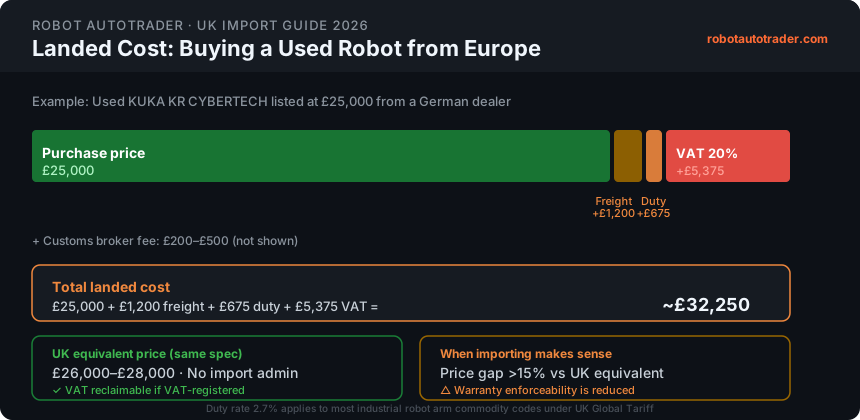
UK import duty is charged on the customs value of the goods, which includes the cost of the robot plus the cost of shipping to the UK port of entry. VAT is then charged at 20% on the total of: the customs value, plus the duty itself, plus any other import charges.
Here is what that looks like on a concrete example. A used KUKA KR 120 R2500 listed by a Spanish dealer at €25,000:
| Item | Amount |
|---|---|
| Robot purchase price (€25,000 at 1.17 GBP/EUR) | £21,368 |
| International freight (Spain to UK, 350kg machine) | £1,800 |
| Customs value (robot + freight) | £23,168 |
| Import duty at 2.7% | £625 |
| VAT base (customs value + duty) | £23,793 |
| VAT at 20% | £4,759 |
| Import agent / customs broker fee | £350 |
| Total landed cost | £28,902 |
A comparable KUKA KR 120 R2500 from a UK-based reseller in similar condition is typically listed at £23,000 to £26,000. The Spanish machine, which looked £3,000 to £4,000 cheaper on paper, arrives at roughly the same price, and that is before accounting for any currency movement between agreement and payment.
Country of Origin: The Detail Most Buyers Miss
The 2.7% duty rate applies to robots of EU origin. This is where the calculation becomes considerably more complicated for buyers who do not know to ask the question.
A KUKA robot assembled at the company's manufacturing facility in Augsburg, Germany, is unambiguously of German (EU) origin. The 2.7% rate applies.
A FANUC robot is a different matter. FANUC manufactures its robots primarily in Japan. A unit that was sold new to a German automotive plant in 2018, decommissioned in 2024, and listed by a Spanish refurbishment dealer in 2025 was originally manufactured in Japan. The fact that it sat in a German factory for six years, and was then refurbished in Spain, does not change its country of manufacture for tariff purposes.
For robots of Japanese origin, the UK-Japan Comprehensive Economic Partnership Agreement (CEPA) provides a preferential rate, but that rate still applies, and documentation requirements are more complex. For Chinese-manufactured robots, standard UK tariff rates apply, which can be higher.
The practical upshot is that buyers purchasing from European dealers need to ask for the original certificate of origin and confirm with a UK customs broker what rate will apply before committing to the purchase. Dealers are not always forthcoming with this information, and some are not entirely clear on it themselves.
The Warranty Problem
Used robot dealers across Europe commonly offer warranty periods of three to six months. For a UK buyer, these warranties carry a specific and significant practical limitation: they are very difficult to enforce.
Consider what a warranty claim actually involves. The robot develops a fault. You contact the Spanish dealer. They ask you to ship the machine back for inspection and repair. You are now looking at arranging a specialist haulage contractor, export documentation, repackaging a machine that weighs 300kg, and a transit time of seven to fourteen days each way, all at your cost, before the warranty claim is even assessed.
In most cases, the economics of a warranty claim for a UK buyer purchasing from a continental European dealer simply do not work. The cost of shipping the machine exceeds the cost of local repair, which means the warranty is functionally worthless.
This is not a criticism of European dealers as a category. Many operate to high standards. The problem is structural: a warranty that requires the buyer to ship heavy industrial equipment across an international border is not a warranty that a buyer can realistically exercise.
What UK Warranty Actually Looks Like
A reputable UK-based used robot reseller offers warranty on an entirely different basis. Warranty claims are carried out at their UK workshop or, for fixed installations, by sending a qualified engineer to your site. There is no international shipping, no customs complication, and no multi-week delay while the machine transits across Europe.
The difference between a six-month warranty from a UK reseller and a six-month warranty from a continental European dealer is not six months of the same thing. It is the difference between genuine protection and a contractual commitment that cannot practically be enforced.
The Service Network Advantage of Buying UK
ABB, KUKA, FANUC, Universal Robots, and Yaskawa all maintain substantial UK service networks. This matters when things go wrong, and with complex industrial machinery, things eventually go wrong regardless of the purchase source.
UK-based service engineers mean faster response times, parts held in UK stock rather than shipped from central European distribution, and no international customs clearance on replacement components. For production environments where robot downtime has a direct cost, these factors are not marginal.
Buying through a UK-accredited reseller often provides an additional layer of service benefit. Established UK resellers typically have pre-existing relationships with manufacturer service networks and, in many cases, their own qualified engineers on staff. That relationship translates to faster prioritisation when service is needed.
Buying from a European dealer does not close off manufacturer service in the UK, but it does remove the reseller layer, meaning the buyer manages the manufacturer relationship directly. For UK buyers without internal engineering resource, that is a meaningful additional responsibility.
Currency Risk: The Hidden Cost That Moves Against You
Sterling and the euro move. They have always moved. The GBP/EUR rate has ranged between approximately 1.10 and 1.22 over the past two years, a spread of roughly 10%.
When a European dealer lists a robot at €30,000, the sterling equivalent depends entirely on the exchange rate at the time of payment. A rate of 1.20 gives a sterling cost of £25,000. A rate of 1.14, not unusual during periods of sterling weakness, gives £26,316. On the full transaction, including duty and VAT calculated on the sterling equivalent, the total landed cost can shift by £1,500 or more based purely on exchange rate movement.
UK-sourced robots are priced and invoiced in sterling. There is no exchange rate exposure. The price you agree is the price you pay.
When Importing from Europe Does Make Sense
The case against importing is strong in most circumstances. There are, however, situations where the mathematics work in the buyer's favour.
Rare or unavailable models. If you need a specific robot that has not come to market in the UK in twelve months of searching, sourcing from continental Europe may be the only option. The additional cost of import is less relevant if there is no domestic alternative.
Very high-value units. On a robot priced at €120,000, a 2.7% duty plus VAT still applies, but the absolute saving versus a UK equivalent (if one exists) can be large enough to justify the additional complexity. The economics of importing a robot worth £100,000 are different from importing a robot worth £25,000.
Buyers with internal service capability. If your organisation has qualified robot engineers on staff and does not depend on the seller for ongoing support, the warranty and service network arguments against European sourcing are substantially weaker. You are, in effect, your own service network.
When you have a currency hedge. Businesses with euro-denominated revenues or standing hedging arrangements may be able to fix the exchange rate at the time of agreement, removing the currency risk entirely.
What to Look for in a UK-Based Used Robot Seller
Given that UK sourcing is the right choice for most buyers, the quality of the specific UK reseller matters considerably. Not all used robot dealers operate to the same standard.
The questions to ask before committing:
Was the robot physically inspected and tested by a qualified engineer? Reputable resellers will have documentation of the inspection and, where refurbishment was carried out, a record of what was done. A robot that has been "tested" without documentation of what was checked is not a robot that has been properly assessed.
What are the warranty terms, and how are warranty claims handled? The answer should specify clearly where warranty work is carried out (ideally at the seller's UK premises or on-site) and who carries it out (ideally the seller's own engineers or a named service partner).
Does the seller hold spare parts for the model? Common wear parts, batteries, and key consumables held in UK stock mean faster resolution of minor issues. A seller who sources all parts from continental European distribution adds lead time to every repair.
Can the seller provide commissioning and ongoing support? For buyers without internal robot expertise, the ability to call on the seller's engineers for installation, programming, and troubleshooting is valuable beyond the initial purchase.
Does the seller physically hold the robot? Some UK-listed used robots are actually held by European partners and shipped only after sale. These listings carry the import complexity described above, even if the intermediary is UK-registered. Always confirm the robot's physical location before proceeding.
Robot AutoTrader: UK-Native, UK-Sourced
Robot AutoTrader lists used and refurbished robots held by UK-based resellers, with transparent pricing in sterling. Every listing specifies the robot's physical location, the warranty terms, and the seller's service capability. There are no currency surprises, no import duty calculations, and no warranty commitments that require international shipping to exercise.
If you are searching for a specific model, the used robot listings cover KUKA, ABB, FANUC, Universal Robots, Yaskawa, and dozens of further brands, all sourced from verified UK sellers.
For buyers working through the buy vs. import decision on a specific machine, the used robot price guides provide current UK market pricing by brand and model, giving you an accurate baseline for comparison.
FAQ: Buying Used Robots UK vs Europe
Can I import a used robot from Europe to the UK?
Yes, you can. Post-Brexit, robots imported from EU member states are subject to UK customs duty (typically 2.7% for industrial robots under HS code 8479.50) plus 20% VAT applied to the combined cost of the robot, duty, and shipping. On a €25,000 robot, total landed cost in the UK often exceeds £28,000 once all charges are accounted for, which frequently erodes any apparent saving versus buying from a UK reseller.
What HS code applies to industrial robots imported into the UK?
Most industrial robot arms are classified under HS code 8479.50 (industrial robots, not elsewhere specified). The current UK Global Tariff rate from EU origin is 2.7%. However, robots that are primarily laser machines, welding machines, or include significant integrated tooling may be classified differently. Always confirm the correct commodity code with a customs broker before committing to a purchase.
Does country of origin affect the import duty on a used robot?
Yes, significantly. A KUKA robot assembled in Germany qualifies for the EU-origin rate of 2.7%. A FANUC or other robot originally manufactured in Japan or China, refurbished by a Spanish dealer, and sold from Spain may still carry its original country of manufacture for tariff purposes. Refurbishment in the EU does not automatically change the robot's origin. Buyers frequently overlook this and are surprised when the duty calculation applies a higher rate.
Is a warranty from a European used robot dealer valid in the UK?
Technically, a warranty is a contractual promise between you and the seller. In practice, warranty claims on a 300kg robot arm sold by a dealer in Spain are extremely difficult to enforce from the UK. Shipping the robot back to Spain for warranty repair is rarely economical. UK buyers should treat warranties from non-UK dealers as largely unenforceable and factor the cost of local repairs into any purchase decision.
Do robot manufacturers like ABB, KUKA, and FANUC support used robots bought abroad?
Manufacturer service networks support robots by model and serial number, not by purchase location. The practical advantage of buying through a UK-accredited reseller is that they often have pre-negotiated service relationships and hold local spare parts stock, which reduces lead times on repairs significantly versus sourcing parts from continental European distribution.
When does importing a used robot from Europe actually make financial sense?
Importing makes sense in a narrow set of circumstances: when the robot model you need is simply not available in the UK, when you are buying a high-value unit (£80,000 or more) where even a 2.7% duty on a substantial discount produces a meaningful net saving, or when you have your own internal service capability and do not depend on the seller for ongoing support. For standard industrial robots under £50,000, UK-sourced units almost always offer better total cost of ownership.
How does currency risk affect buying a used robot from Europe?
Euro-denominated prices look attractive when sterling is relatively strong. However, a 5% shift in the GBP/EUR rate during a two to four week transaction period is not unusual. On a €30,000 robot, that represents a swing of roughly £1,300, which may absorb much of the apparent saving. UK-sourced robots are priced in sterling, eliminating this risk entirely.
What should I look for when buying a used robot from a UK reseller?
Key criteria include: whether the robot was physically inspected and refurbished by a qualified engineer, what the warranty terms are and whether the seller carries out warranty repairs at their UK premises, whether the seller stocks common spare parts for the model, whether the seller can provide a service engineer for commissioning and support, and whether the robot is actually physically held in the UK rather than by a European partner awaiting sale. A reputable UK reseller will be able to answer all of these questions clearly and with supporting documentation.