
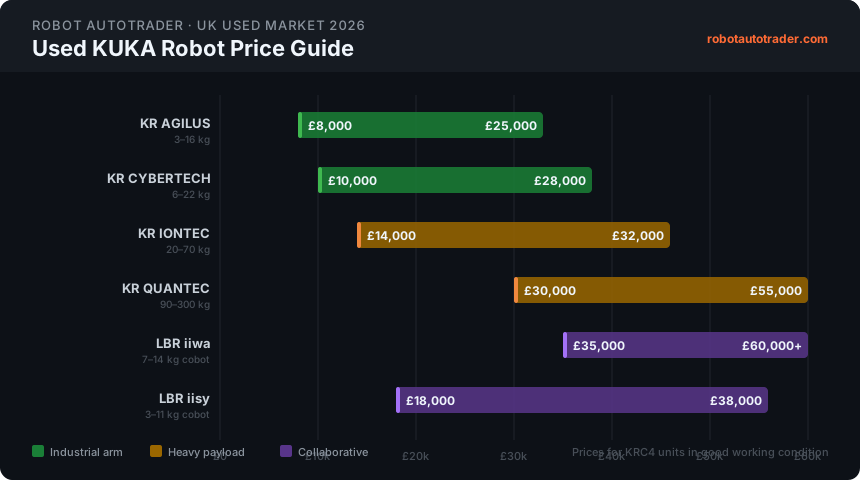
> Quick answer: Used KUKA robots in the UK range from £8,000 for a small KR AGILUS to over £55,000 for a large KR QUANTEC. The most common used models, KR CYBERTECH arms with a KRC4 controller, cost £10,000 to £20,000 and represent 45 to 55% savings versus new. LBR iiwa cobots trade at £20,000 to £35,000 used.
Used KUKA Robots Price Guide UK 2026
KUKA is the most widely installed brand of industrial robot arm in UK manufacturing. Decades of automotive, aerospace, and general manufacturing deployments mean there is a consistent supply of used KUKA units entering the secondary market each year. Whether through factory decommissions, line upgrades to newer KUKA models, or equipment lease returns, the UK used KUKA market is one of the deepest and most liquid in the industrial robot segment.
That depth creates opportunity. It also creates complexity. A KUKA KR QUANTEC with a KRC2 controller and 28,000 hours is a fundamentally different purchase from the same arm with a KRC4 controller and 12,000 hours, even if the two look identical in a stock photograph. This guide maps the UK used price landscape for every major KUKA model, explains what drives the differences, and tells you what to check before committing.
Used KUKA Robot Prices: Full Model Table 2026
The prices below reflect actual UK market transactions and listings observed through October 2026. They represent the realistic range for serviceable units, excluding non-running or heavily worn machines at the bottom and freshly refurbished OEM-certified units at the top.
| Model | Payload | Reach | New Price (approx) | Used Price (UK) | Saving vs New |
|---|---|---|---|---|---|
| KR AGILUS KR6 R900 | 6 kg | 900 mm | £28,000 | £8,000 - £16,000 | 43 - 71% |
| KR CYBERTECH KR10 R1100 | 10 kg | 1,101 mm | £35,000 | £10,000 - £20,000 | 43 - 71% |
| KR CYBERTECH KR16 R1610 | 16 kg | 1,611 mm | £40,000 | £12,000 - £22,000 | 45 - 70% |
| KR IONTEC KR20 R1810 | 20 kg | 1,813 mm | £38,000 | £15,000 - £25,000 | 34 - 61% |
| KR QUANTEC KR120 R2100 | 120 kg | 2,101 mm | £75,000 | £25,000 - £45,000 | 40 - 67% |
| KR QUANTEC KR210 R2700 | 210 kg | 2,701 mm | £90,000 | £30,000 - £55,000 | 39 - 67% |
| LBR iiwa 7 R800 | 7 kg | 800 mm | £55,000 | £20,000 - £35,000 | 36 - 64% |
| LBR iisy 11 R1300 | 11 kg | 1,300 mm | £50,000 | £22,000 - £32,000 | 36 - 56% |
Prices in GBP, excluding VAT, as of October 2026. Controller, end-of-arm tooling, and installation excluded unless stated.
KRC4 vs KRC2: The Single Most Important Price Driver
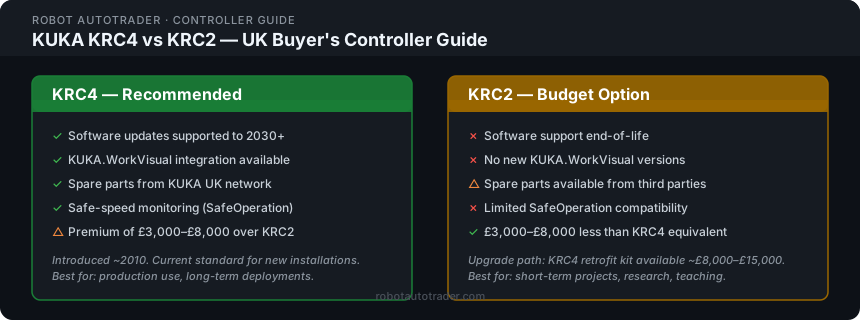
No factor has a greater impact on used KUKA pricing than the controller generation. The difference between a KRC4 and a KRC2 robot of otherwise identical specification can be £3,000 to £8,000 on a mid-range arm and up to £12,000 on a heavy-payload QUANTEC unit.
KRC4 (current generation, 2010-present)
The KRC4 is KUKA's current controller platform and remains fully supported. Software updates continue to be issued. KUKA WorkVisual configuration software, KUKA.Sim simulation packages, and the full range of KUKA technology packages (seam tracking, conveyor synchronisation, arc welding, palletising) are all compatible. Spare parts are manufactured and stocked. KUKA UK will provide full service contracts on KRC4 units.
Used pricing for KRC4 robots reflects this support position. A KR CYBERTECH KR10 with a KRC4 cabinet in good condition will typically achieve £14,000 to £20,000 on the UK market.
KRC2 (legacy generation, pre-2010)
The KRC2 was KUKA's primary controller from roughly 2002 to 2010. It is no longer supported with software updates and KUKA has progressively wound down active support for the platform. Spare parts remain available from third parties and some authorised distributors, but supply is tightening as production has ceased.
Buying a KRC2 robot is not inherently wrong, particularly for a contained internal application with an experienced in-house maintenance team. The risk is that the controller becomes a limiting factor before the arm's mechanical life is exhausted. A KRC2 robot with the same mechanical condition as its KRC4 equivalent typically trades at a 25 to 40% discount, representing this risk.
Controller upgrade option
It is possible to retrofit a KRC4 cabinet onto a mechanically sound KRC2-era arm. Costs for this are substantial, typically £12,000 to £20,000 including labour, and the economics only make sense for heavy-payload QUANTEC units where the mechanical value of the arm justifies the investment. For smaller arms, buying a KRC4-equipped unit directly is almost always more cost-effective.
KR AGILUS: Compact 6kg Arms at £8,000 to £16,000
The KR AGILUS series was introduced around 2012 as KUKA's answer to the growing demand for compact, fast, clean-room-capable 6-axis arms in small-part assembly and electronics applications. First-generation KR AGILUS units are now entering the used market in volume.
The KR6 R900 is the most common variant in the UK. New price is approximately £28,000 for the arm alone, rising to £35,000 to £45,000 fully configured with controller and software. Used prices range from £8,000 for a high-hour unit with a KRC4 controller in need of servicing, up to £16,000 for a clean, low-hour example with documentation.
Buyers should note that the KR AGILUS was designed for high-cycle applications. Units from automotive sub-assembly lines may have accumulated 20,000 to 30,000 hours despite being only six to eight years old. Always confirm operational hours and the application history before purchase.
KR CYBERTECH: The Workhorse of the UK Used Market
The KR CYBERTECH series (previously marketed under designations including KR 6, KR 10, KR 16 in the pre-series naming convention) is the single most common KUKA robot on the UK used market. Payloads from 6kg to 22kg cover the vast majority of general manufacturing applications, and thirty years of factory installations mean supply is consistent.
The most liquid segment is the 10kg to 16kg class, the KR10 R1100 and KR16 R1610. These are strong all-round picks for welding, machine tending, assembly, and material handling applications.
Used price guide for KR CYBERTECH:
- KRC4 controller, under 15,000 hours, full documentation: £15,000 to £20,000
- KRC4 controller, 15,000 to 25,000 hours, service history available: £10,000 to £15,000
- KRC2 controller, any hours, untested: £5,000 to £9,000
The KRC2 units in the lower price band are appropriate for buyers with strong internal KUKA expertise who intend to use the arm for a limited-duration project or who are willing to invest in a controller upgrade.
KR IONTEC: The Mid-Market Newcomer
The KR IONTEC was launched in 2019 as a modernised mid-range series, replacing earlier medium-payload KUKA lines. The KR20 R1810 is the benchmark model, offering 20kg payload and 1,813mm reach in a compact package well-suited to modern flexible manufacturing.
Because the KR IONTEC is a relatively recent model, used supply is smaller and concentrated in higher-condition examples. Prices of £15,000 to £25,000 represent good value for a current-generation arm. The KRC5 controller option, available on later production units from around 2022 onwards, is beginning to appear on the used market and commands a modest premium over KRC4-equipped equivalents.
KR QUANTEC: Heavy Payload at Significant Savings
The KR QUANTEC series covers payloads from 90kg to 300kg and reach up to 3,900mm, making it the dominant choice for UK automotive body-in-white, casting, and heavy material handling applications. New prices for QUANTEC units are substantial, which means the used market savings are correspondingly large in absolute terms.
A KR QUANTEC KR120 R2100 new costs approximately £75,000 for the arm. On the UK used market, well-maintained KRC4 examples with under 20,000 hours trade at £35,000 to £45,000. Units with KRC2 controllers or higher hour counts are available from £25,000.
The KR210 R2700 is the most capable commonly traded QUANTEC variant. New price is approximately £90,000. Used prices range from £30,000 for a project unit requiring work to £55,000 for a recent low-hour example with full documentation.
QUANTEC-specific considerations: Axis 1 and 2 bearing wear is the primary mechanical concern on high-hour QUANTEC units. Replacement costs are significant. Request Mada diagnostic data for all six axes and pay particular attention to the motor temperature profiles for axes 1 and 2 under the logged operational data.
LBR iiwa and LBR iisy: KUKA Cobots on the Used Market
KUKA's collaborative robot range, the LBR iiwa and the newer LBR iisy, occupies a different used market position from the industrial arms. Both models are sensitive-application robots designed for direct human-robot interaction, and buyers should scrutinise their collision history more carefully than for a caged industrial arm.
LBR iiwa 7 R800: KUKA's flagship research and precision assembly cobot since 2013. The iiwa's torque sensing in all seven joints makes it uniquely capable for assembly, medical device handling, and laboratory automation. Used prices of £20,000 to £35,000 represent genuine value given the iiwa's capability level, though buyers should note that software licensing (particularly KUKA Sunrise OS and any application-specific technology packages) must be verified and transferred correctly.
LBR iisy 11 R1300: The LBR iisy is KUKA's more accessible cobot line, introduced in 2021. The 11kg payload version with 1,300mm reach is a capable general-purpose cobot. Being a more recent model, used supply is moderate and condition tends to be good. Prices of £22,000 to £32,000 are typical, with the higher end commanded by recent units with active software licences.
What Drives Used KUKA Robot Prices
1. Controller generation
As discussed, KRC4 versus KRC2 is the dominant price driver, worth 25 to 40% difference on equivalent arms.
2. Operational hours
Under 15,000 hours is low mileage for a KUKA industrial arm. 15,000 to 25,000 hours is normal working life territory. Above 25,000 hours, budget for joint servicing. The Mada system logs hours accurately and cannot be reset without leaving traces in the diagnostic data.
3. Payload class
Heavier-payload arms cost more new and depreciate more slowly in percentage terms, though the absolute saving versus new is larger. A KR QUANTEC at 50% below new represents a saving of £35,000 to £45,000. The economics of buying used are strongest in the heavy-payload segment.
4. Condition and documentation
Full documentation, including the original load data protocol, mastering records, and service history, adds demonstrable value. A KUKA robot without mastering documentation may need to be re-mastered from scratch, which requires specialist equipment and adds cost.
5. Accessories and end-of-arm tooling
A robot sold with the original dress pack, cable management, and application-specific end-of-arm tooling in working condition commands a meaningful premium over a bare arm. Where the tooling is specific to your application, this can represent significant cost saving.
Most Common KUKA Models in the UK Used Market
The UK's industrial heritage, particularly in automotive manufacturing (Jaguar Land Rover, Stellantis, Nissan, and their supply chains), means the used KUKA market skews heavily toward automotive-grade arms.
Most frequently listed models, in order:
- KR CYBERTECH KR16 R1610 and predecessors (high volume, broad payload range)
- KR QUANTEC KR120 R2100 (automotive body-in-white decommissions)
- KR CYBERTECH KR10 R1100 (general assembly and machine tending)
- KR AGILUS KR6 R900 (electronics and small-part assembly)
- KR IONTEC KR20 R1810 (growing supply as early deployments mature)
- LBR iiwa 7 (research and precision assembly, lower volume but growing)
The concentration of automotive applications in the UK used supply means that many available units have been run in continuous multi-shift operation and may have higher hours than equivalent machines from lighter industries. Always confirm application history as well as hours.
Where to Buy Used KUKA Robots in the UK
Robot AutoTrader is a specialist UK marketplace for used industrial and collaborative robots, with detailed condition ratings, operator history, and verified pricing. KUKA listings are among the most frequently updated categories.
Surplex is the largest European used machinery auction platform and regularly lists UK and continental European KUKA units. Auction prices can be competitive but condition information is sometimes limited. Commission and logistics costs add to the hammer price.
Machineseeker is a European classified advertising platform with a strong industrial robot section. Seller quality varies, and buyers should conduct due diligence on any unfamiliar seller.
TM Robotics is an authorised KUKA distributor in the UK and maintains a stock of refurbished and used KUKA robots. Units sold through TM Robotics come with a degree of vetting that private listings cannot provide, reflected in a price premium.
Direct from factories: Major decommissioning events, particularly automotive plant retooling cycles, can produce significant volumes of used KUKA robots available directly from the operator. These routes require industry contacts but can yield well-maintained units at below-market prices.
Industrial auction houses: Euro Auctions, Hilco Industrial, and Ritchie Bros. regularly conduct UK factory clearance auctions. KUKA robots appear at these events, sometimes in significant numbers. Inspection opportunities before sale are limited and warranties are not provided.
What to Check Before Buying a Used KUKA Robot
Mada diagnostics
KUKA's Mada (Machine Data) system stores operational data including motor temperatures, current draws, and error logs for each axis. A Mada report is the most reliable tool for assessing mechanical condition. Any seller refusing to provide or run Mada data is a significant red flag.
Key Mada indicators: motor temperature peaks (elevated peaks suggest worn bearings or inadequate cooling), brake resistance values (deteriorating brakes are expensive to rectify), and gear unit temperature profiles.
Joint logs and collision records
The KRC4 controller logs joint movement and collision events. Review the joint log for any recorded collisions or overload events. A single hard collision on a KUKA arm does not necessarily mean terminal damage, but it does mean specific inspection of the affected joints is required.
Controller cabinet condition
The KRC4 cabinet contains the power electronics and computing hardware for the robot. Inspect the internal condition for signs of moisture ingress, overheating (discoloured components or wiring), or evidence of repairs using non-standard parts. The hard drive is a particular point of failure on older KRC4 units and is worth replacing as a precaution if the robot has significant hours.
Mastering verification
All KUKA robots are mastered (zeroed) at the factory using precise reference marks on each joint. Verify that the mastering marks are undisturbed and that the mastering protocol document matches the serial number of the robot. Evidence of re-mastering without documentation may indicate an unrecorded collision or repair.
Live demonstration under load
Always request a live demonstration running a representative programme under load conditions. A robot that runs smoothly with no load may still exhibit compliance or vibration issues at working payloads. If the seller cannot provide a live demonstration, the risk premium should be reflected in the price.
KUKA Service and Support in the UK
KUKA UK is headquartered in Halesowen, West Midlands, and provides the primary OEM support network. KUKA UK offers service contracts, remote diagnostic support via KUKA Connect, and technical training for KRC4-generation robots. For KRC2 robots, KUKA UK will provide parts on a best-efforts basis but does not offer active support contracts.
Regional KUKA-certified integrators and service companies provide an alternative and frequently more accessible support route, particularly outside the Midlands and South East. Well-regarded independent KUKA specialists active in the UK market include EEF Robots, RobotWorx Europe (US-based with UK service capability), and various regional automation integrators with KUKA OEM service accreditation.
Spare parts for KRC4 robots are available from KUKA UK and authorised distributors. A small but functional grey-market parts ecosystem also exists for both KRC4 and KRC2 components, though parts quality from non-authorised sources is variable.
Summary: What to Pay for a Used KUKA Robot in the UK
For most buyers, the clearest guidance is:
- Target KRC4-equipped units. The controller premium is almost always worth paying for the remaining software support life and parts availability.
- Buy at under 20,000 hours where possible. Units in the 10,000 to 18,000-hour range represent the best combination of price and remaining service life.
- Budget for inspection. A Mada diagnostic report from a qualified KUKA technician costs £300 to £600 and is the best investment you can make before a purchase.
- The KR CYBERTECH series at £12,000 to £20,000 is the most liquid and best-supported segment of the UK used KUKA market. For heavy-payload requirements, the KR QUANTEC delivers the largest absolute saving versus new.
Frequently Asked Questions
How much does a used KUKA robot cost in the UK?
Used KUKA robots range from around £8,000 for a small KR AGILUS KR6 to over £55,000 for a heavy-payload KR QUANTEC KR210. The most common mid-range models, KR CYBERTECH units in the 10 to 16kg payload class, typically trade between £10,000 and £20,000. Price depends heavily on controller generation, payload, age, and condition.
What is the difference between a KUKA KRC4 and KRC2 controller?
KRC4 is KUKA's current controller generation, introduced around 2010 and still supported with software updates and spare parts. KRC2 is the previous generation and is effectively end-of-life for software support, though spare parts remain available. A KRC4-equipped robot commands a premium of £3,000 to £8,000 over an equivalent KRC2 unit, which is usually justified by remaining software support life and lower long-term risk.
Is buying a used KUKA robot worth it compared to buying new?
Yes, for most applications. A well-maintained KUKA KR CYBERTECH or KR QUANTEC with a KRC4 controller and under 25,000 operational hours typically retains 80 to 90% of its new-condition capability while costing 40 to 55% less than new. The key is factoring in inspection costs and, for KRC2 units, the potential cost of a controller upgrade.
What KUKA models are most commonly available used in the UK?
The KR CYBERTECH series (particularly the KR10 R1100, KR16 R1610, and their predecessors) is the most common on the UK used market, followed by the KR QUANTEC for heavier payloads. The KR AGILUS is increasingly available as first-generation units mature. LBR iiwa cobots are available but command higher prices due to their collaborative capability.
Where can I buy used KUKA robots in the UK?
The main sources are: Robot AutoTrader (specialist UK used robot marketplace), Surplex (European auction platform), Machineseeker (European classified platform), TM Robotics (authorised KUKA distributor with refurbished stock), direct from factories decommissioning lines, and industrial auction houses such as Euro Auctions and Hilco Industrial.
What should I check before buying a used KUKA robot?
The critical checks are: run KUKA's Mada diagnostic software to read joint motor data; review the controller log for error codes and service history; inspect the joint mastering marks for evidence of unrecorded collisions; check KRC4 hard drive health; and verify all documentation including the load data and mastering protocol. Always request a live demonstration under load before purchase.
How many operational hours should I expect from a used KUKA robot?
A well-maintained KUKA industrial arm has a design life of around 30,000 to 40,000 operational hours for the primary axes. Units with under 20,000 hours represent the sweet spot of the used market. Above 25,000 hours, budget for joint servicing or overhaul, particularly on axes 1 and 2 which carry the greatest load.
Does KUKA provide support for used robots in the UK?
KUKA provides support through its UK subsidiary KUKA UK, headquartered in Halesowen, West Midlands. Full service is available for all KRC4-generation robots. KRC2 robots receive limited support, primarily parts supply. Independent KUKA specialists and regional automation integrators also provide service, often at lower cost than the OEM for routine maintenance and repairs.