
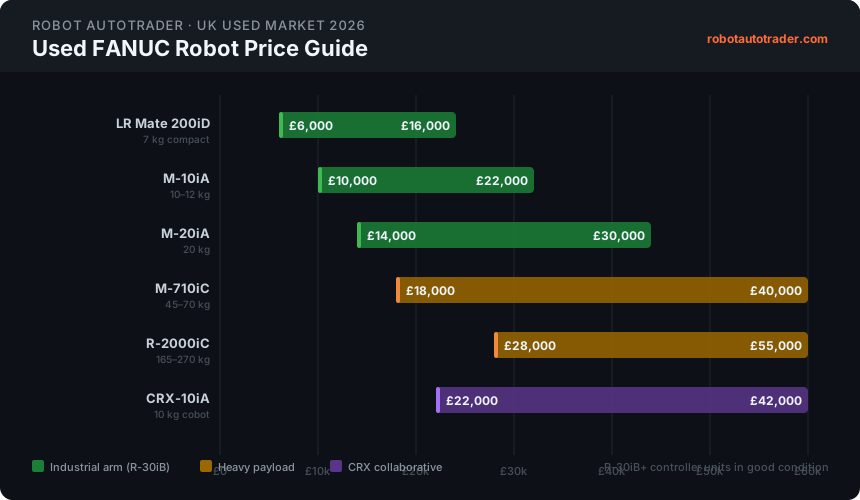
> Quick answer: Used FANUC robots in the UK cost £6,000 to £48,000 depending on model and condition. The LR Mate 200iD starts from around £6,000 for older units. The popular M-10iA trades at £10,000 to £20,000. The heavy-duty R-2000iC ranges from £28,000 to £48,000. FANUC CRX cobots hold value strongly, with used prices at £14,000 to £25,000. All prices assume an R-30iB or R-30iB Plus controller in working order.
Used FANUC Robots Price Guide UK 2026
FANUC makes more robots than any other manufacturer in the world. The company passed the one million cumulative robots shipped milestone in 2019 and has continued at pace since. In the UK, FANUC robots dominate the automotive, aerospace, food, and general manufacturing sectors, and that deep install base means the used market is the most liquid of any industrial robot brand.
This guide covers every major FANUC series available on the UK used market in 2026: what they cost new, what they cost used, which controller generation to look for, and what to check before buying.
FANUC Used Robot Prices at a Glance
The table below shows current UK used market price ranges for the most traded FANUC models. Prices reflect units in working condition with an R-30iB or R-30iB Plus controller. Units with older R-30iA controllers sell at the lower end or below the ranges shown.
| Model | Payload | Reach | New Price (approx.) | Used UK Price | Saving |
|---|---|---|---|---|---|
| LR Mate 200iD | 7 kg | 717 mm | ~£22,000 | £6,000 – £16,000 | 27 – 73% |
| M-10iA/10 | 10 kg | 1,420 mm | ~£35,000 | £10,000 – £20,000 | 43 – 71% |
| M-20iA/20 | 20 kg | 1,811 mm | ~£42,000 | £14,000 – £24,000 | 43 – 67% |
| M-710iC/70 | 70 kg | 2,050 mm | ~£60,000 | £20,000 – £38,000 | 37 – 67% |
| R-2000iC/165 | 165 kg | 2,655 mm | ~£80,000 | £28,000 – £48,000 | 40 – 65% |
| CRX-5iA (cobot) | 5 kg | 994 mm | ~£28,000 | £14,000 – £20,000 | 29 – 50% |
| CRX-10iA (cobot) | 10 kg | 1,418 mm | ~£35,000 | £17,000 – £25,000 | 29 – 51% |
Prices correct as of October 2026. Private sale prices from direct business disposals are typically 10 to 15% lower than dealer prices.
FANUC LR Mate 200iD: The Compact Workhorse
The LR Mate 200iD is FANUC's compact tabletop robot, covering 7 kg payload and a 717 mm reach in a footprint that fits easily into machine tending and small-part assembly cells. It is one of the most widely deployed small industrial robots in Europe, and used examples appear regularly on the UK market from electronics, pharmaceutical, and food packaging decommissions.
Used price range: £6,000 to £16,000
Older examples with R-30iA controllers represent the lower end of this range and are usable but require more maintenance budget. LR Mate units with the R-30iB Plus and integrated iRVision command the upper end. A clean, low-hours unit from a pharmaceutical line can trade close to £16,000 because pharmaceutical buyers often run robots well below capacity in climate-controlled environments.
The most common issue on used LR Mate units is teach pendant cable wear, as the compact workcell footprint often means the teach pendant cable is routed tightly. Inspect the cable carefully at both ends.
FANUC M-10iA: The Most Common FANUC on the UK Used Market
The M-10iA series is the backbone of the UK FANUC used market. With 10 kg payload and a reach just over 1.4 metres, it covers a vast range of arc welding, machine tending, assembly, and light material handling applications. The volume of units in service means supply is consistent and prices are competitive.
Used price range: £10,000 to £20,000
The M-10iA has gone through several variants, the most important being the M-10iA/10 (10 kg payload, 1,420 mm reach) and the M-10iA/12 (12 kg payload, same reach). The 12 kg variant is slightly newer and commands a small premium. Both are excellent purchases.
Look for units with an R-30iB or R-30iB Plus controller. The software ecosystem for M-10iA is extremely mature, with FANUC TP programs, Karel, and the FANUC Roboguide simulation package all fully supported. Many integrators have M-10iA experience, which keeps commissioning costs competitive.
Key inspection point: Joint J3 on the M-10iA carries high load in typical machine-tending postures. Request the joint torque log from the diagnostics and look for consistently elevated readings on J3, which may indicate worn harmonic drives.
FANUC M-20iA: More Payload, Same Reliability
The M-20iA steps up to 20 kg payload at a 1,811 mm reach, making it suitable for heavier material handling, spot welding with gun weight, and palletising of smaller loads. It shares the same control architecture as the M-10iA and the same FANUC support coverage.
Used price range: £14,000 to £24,000
The M-20iA/20 (20 kg) and M-20iA/25 (25 kg, shorter reach) are the most common variants on the UK used market. Automotive sector disposals supply most of the used M-20iA stock, as the robot was widely used for spot welding and assembly. Automotive-origin robots tend to be high hours but well maintained because production lines require predictable uptime.
When buying a used M-20iA from an automotive background, ask for the maintenance history log. FANUC robots on automotive lines are typically serviced to manufacturer schedule because line downtime costs are severe. This makes automotive provenance a positive indicator for FANUC, unlike some other use cases.
FANUC M-710iC: The Mid-Range Heavy Lifter
The M-710iC is FANUC's mid-range heavy-duty robot series, covering payload capacities from 45 kg to 70 kg at reaches of 2.05 to 2.35 metres. It is the second most commonly available FANUC model on the UK used market after the M-10iA and the preferred choice for automotive body shop, palletising, and heavy assembly applications.
Used price range: £20,000 to £38,000
The M-710iC/70 (70 kg payload) is the most traded variant. FANUC's floor-mount, ceiling-mount, and angled configurations all use the same robot body, so used M-710iC units originally installed at different orientations are directly interchangeable.
The M-710iC generation covered by this guide uses the R-30iB and R-30iB Plus controllers. An older R-30iA version exists, trading at the bottom of or below this range, but the R-30iA is now out of standard FANUC support and should be approached cautiously unless the buyer has in-house FANUC engineering capability.
Most common issue: Cable dress. On M-710iC installations where the cable dress was not set up correctly for the robot's typical path, J1, J2, and J3 cables can develop chafe points. Inspect the full cable run carefully and budget for redressing if necessary.
FANUC R-2000iC: Heavy Payload Flagship
The R-2000iC is FANUC's heavy payload flagship, covering loads from 125 kg to 270 kg depending on variant. The R-2000iC/165 (165 kg payload, 2,655 mm reach) is the most common on the UK used market and the standard choice for large-part handling, heavy spot welding, and automotive assembly.
Used price range: £28,000 to £48,000
New R-2000iC units are a significant capital investment at around £80,000, which makes the used market an attractive entry point for manufacturers who need the payload class. The robots are extremely durable in automotive environments and used examples frequently have many years of reliable service remaining.
The R-2000iC produces a large saving versus new while still benefiting from FANUC's excellent UK parts availability and service network. This is one of the most compelling arguments for the used FANUC market: a robot this capable, this well-supported, at a price point accessible to mid-size manufacturers.
Inspection note: R-2000iC units from spot welding applications will have experienced significant J1 and J2 rotational loads. Confirm joint health via the FANUC diagnostic and physically check each joint for smooth operation, unusual noise, and backlash.
FANUC CRX Cobots: Used Pricing and What You Get
FANUC launched the CRX series as its collaborative robot offering, with a philosophy of simplicity: tablet-based drag-and-drop teach programming, no integration expertise required for basic applications, and force-sensing safety enabling deployment alongside workers without fencing in most configurations.
CRX-5iA
Used price range: £14,000 to £20,000 New price: approximately £28,000
The CRX-5iA covers 5 kg payload at a 994 mm reach. It is well suited to light assembly, dispensing, machine tending on compact cells, and laboratory automation. As a relatively recent product the used supply is limited, which keeps prices firm.
CRX-10iA
Used price range: £17,000 to £25,000 New price: approximately £35,000
The CRX-10iA steps up to 10 kg payload at 1,418 mm reach. It is the more popular of the two CRX models and the one most likely to turn up via business disposal as pilot projects are superseded or production lines reconfigured. The CRX-10iA's reach covers a wide range of applications that the CRX-5iA cannot, including machine tending on larger CNC machines.
Both CRX models use FANUC's ZDT (Zero Down Time) cloud monitoring and the same R-30iB Plus controller architecture as the industrial range, with the addition of hand guidance hardware. Software upgrades are the same process as industrial FANUC robots.
Note on CRX used market maturity: The CRX range is still relatively new, which means the used market is less liquid than M-10iA or M-710iC. Expect to spend more time searching, and verify that all safety configuration documentation transfers with the unit, as cobots require a fresh risk assessment at any new installation.
Controller Generations: R-30iA, R-30iB, and R-30iB Plus
The controller generation is one of the most important factors in a used FANUC purchase. FANUC has produced three major controller families relevant to the current UK used market.
R-30iA (Legacy)
The R-30iA was FANUC's standard controller for much of the 2000s and early 2010s. It is functional but now out of FANUC standard support. Spare parts are available but the controller lacks the network connectivity, dual-check safety, and software support of later generations. Avoid unless the price is significantly lower and your application is simple.
R-30iA robots typically trade at 10 to 20% below equivalent R-30iB robots.
R-30iB (Current, Previous Generation)
The R-30iB is the generation to look for in used FANUC purchases. It introduced a higher-performance processor, colour teach pendant (iPendant), improved energy monitoring, and better network support. It supports all current FANUC software options including iRVision, Roboguide, and FANUC Intelligent Edge Link and Drive (FIELD).
This is the minimum controller generation for a sensible used FANUC purchase.
R-30iB Plus (Current Production)
The R-30iB Plus is FANUC's current controller, standard on all new robots. It adds dual-check safety (DCS), improved I/O density, faster Ethernet, and hand guidance support for cobots. Used robots with R-30iB Plus controllers command a premium of roughly 10 to 15% over R-30iB equivalents and represent the best-protected purchase for longevity.
FANUC's Reliability Reputation: What the Numbers Say
FANUC does not widely publish official MTBF figures, but the company has historically communicated internally a target mean time between failures exceeding 80,000 hours, which is approximately 9 years of continuous operation. Field experience broadly supports this: FANUC robots are routinely found in service after 15 to 20 years in automotive and manufacturing environments.
This reliability is not accidental. FANUC designs its robots using its own servo motors, controllers, and sensors, allowing tighter integration and longer-term parts commitment than companies that source from multiple suppliers. FANUC also manufactures its own harmonic drive components for many models.
Routine Maintenance Requirements
Understanding FANUC's maintenance schedule is important when evaluating a used unit and planning total cost of ownership.
Battery replacement: FANUC encoder batteries require replacement every three to five years. A battery that has been allowed to discharge completely can corrupt the mastering calibration, requiring axis recalibration. Check the alarm history for any low-battery warnings and confirm when batteries were last changed.
Joint grease: FANUC specifies grease replenishment intervals of 3,850 hours or three years, whichever comes first. On a used robot, confirm when joints were last greased and budget for the full grease service if the history is unknown. Cost is typically £200 to £500 for a reputable service engineer.
Teach pendant cable: The iPendant cable is the most common wear item on FANUC robots with high teach usage. Inspect the cable along its full length, particularly near the strain relief at the pendant end.
Most Common FANUC Models in the UK Used Market
Based on current listings and market intelligence, the UK FANUC used market is dominated by:
- FANUC M-10iA (most common, consistent supply year-round)
- FANUC M-710iC (strong supply from automotive and palletising disposals)
- FANUC LR Mate 200iD (growing supply as original deployments reach end of planned life)
- FANUC R-2000iC (less frequent but significant asset value; worth monitoring)
- FANUC M-20iA (moderate supply from welding and assembly disposals)
The FANUC CRX range is growing in used availability as early deployments from 2021 to 2023 are reconfigured or replaced with newer variants.
Why FANUC Holds Residual Value Better Than Most Brands
FANUC consistently shows better used market price retention than equivalent robots from smaller or less established brands. The reasons are structural.
Dominant install base. With the largest installed base of any robot manufacturer, FANUC creates a self-reinforcing market. Buyers are confident purchasing used FANUC because they know resellers, integrators, and parts suppliers will still be operating in ten years. This confidence is baked into used prices.
Long parts support commitment. FANUC maintains parts availability for its products well beyond the industry norm. Parts for R-30iA controllers, technically out of standard support, are still available. This long tail of support protects buyers who hold a unit for many years.
Deep integrator ecosystem. Because FANUC robots are so common, virtually every industrial robot integrator in the UK has FANUC experience. Commissioning and redeployment costs are competitive, and specialist FANUC programming expertise is available from freelancers and integrators alike.
FANUC UK direct support. Unlike some Asian brands reliant on a thin distributor network, FANUC UK operates its own direct service operation from Milton Keynes. Field engineers cover the whole country, parts are stocked locally, and emergency response times are competitive. This is a genuine differentiator when calculating total cost of ownership.
Where to Buy Used FANUC Robots in the UK
The UK has a well-developed used FANUC market with several reliable sourcing channels.
Specialist robot resellers and refurbishers are the highest-cost but lowest-risk option. Companies such as EU Automation, Robotics Online Exchange, and regional robot specialists inspect, test, and warranty units before sale. Prices are typically 10 to 20% above raw market, but a warranty and inspection report have real value.
Industrial auctioneers including TBAuctions, BidSpotter, and Euro Auctions regularly list FANUC robots from manufacturing plant disposals. Prices can be significantly below reseller rates but there is no warranty and inspection opportunity is limited. Best suited to buyers with in-house FANUC engineering capability.
Business direct disposals occur when manufacturers decommission lines directly. These can offer excellent prices but require the buyer to conduct full due diligence. Check the Robot AutoTrader marketplace for direct listings from verified UK businesses.
FANUC UK certified pre-owned programme offers inspected units with FANUC warranty via the manufacturer directly. Prices are higher than the open market but the warranty and knowledge that FANUC has inspected the unit has value for risk-averse buyers.
Due Diligence Checklist for Used FANUC Robots
Before committing to a used FANUC purchase, work through the following checks.
Documentation
- Request the full FANUC diagnostic dump (alarm history, maintenance history, joint logs)
- Confirm controller serial number matches the robot serial number
- Ask for original installation risk assessment and any PUWER records
- Verify all software options are licensed to the controller serial number
Physical inspection
- Power up the robot and run it through its full range of motion on each axis
- Listen for bearing noise or grinding on each joint
- Check all cable runs for chafing, particularly around J2 and J3
- Inspect the teach pendant cable and connector at both ends
- Check all axis brake releases for smooth operation
Software and calibration
- Confirm mastering data is intact (robot moves to mastering position without alarm)
- Verify battery voltage is within specification on all axes
- Run a simple test program and confirm repeatability is within specification
- Confirm iRVision or other software options activate if included in the purchase
FAQ: Used FANUC Robots in the UK
How much does a used FANUC robot cost in the UK?
Used FANUC robots in the UK range from around £6,000 for an older LR Mate 200iD to over £48,000 for a recent R-2000iC in excellent condition. The most commonly traded models, the M-10iA and M-710iC, sit in the £10,000 to £38,000 range depending on age, controller generation, and condition. FANUC holds residual value better than most competitors due to its dominant install base and long parts support.
Which FANUC robot is most common on the UK used market?
The FANUC M-10iA is the most frequently available FANUC model on the UK used market, followed closely by the M-710iC. Both are workhorse mid-range robots with broad application coverage, and the large number of units installed means decommissioned stock appears regularly from automotive, food, and general manufacturing disposals.
What is the difference between FANUC R-30iA, R-30iB, and R-30iB Plus controllers?
The R-30iA is the oldest generation and is now out of standard FANUC support. The R-30iB introduced a faster processor, improved energy monitoring, and a colour teach pendant. The R-30iB Plus (current production standard) adds dual-check safety, better network connectivity, and support for FANUC's latest software options including iRVision 3D and hand guidance. For a used purchase, R-30iB or R-30iB Plus is strongly preferred.
Are used FANUC robots reliable?
FANUC has the highest reliability reputation in the industrial robot industry, with a mean time between failures target exceeding 80,000 hours. The most common maintenance issues on used FANUC robots are predictable and inexpensive: battery replacement every three to five years, joint grease replenishment every 3,850 hours, and teach pendant cable wear. None of these are sudden failure modes if serviced on schedule.
How do I check the health of a used FANUC robot?
Request a full FANUC diagnostic dump from the teach pendant including alarm history, maintenance history, and joint torque load logs. High joint torque readings over time indicate joint wear. Check the battery voltage alarm history, as batteries that were allowed to fully discharge can corrupt the mastering data. Inspect all axis cables for chafing, particularly around joints J2 and J3 where cables flex most.
Does FANUC have a strong UK service network?
Yes. FANUC UK operates directly from Milton Keynes with field engineers covering the whole country, and the UK has one of the densest FANUC-certified integrator networks in Europe. Spare parts for all models from the R-30iA era onwards are stocked in the UK, and FANUC's parts catalogue is one of the most extensive in the industry.
Should I buy a FANUC CRX cobot or a FANUC M-10iA?
The CRX and M-10iA serve different applications. The CRX is a collaborative robot designed for deployment alongside workers without safety fencing in most applications, with drag-and-drop teach programming that does not require a specialist. The M-10iA is a full-speed industrial robot that needs safety guarding but offers much faster cycle times. For a light, flexible task without engineering support, CRX is the right choice. For production volume and throughput, M-10iA.
Why do FANUC robots hold their value better than other brands?
Three factors explain FANUC's strong residual values. First, FANUC is the world's largest robot manufacturer by installed base, creating a liquid used market. Second, FANUC maintains parts availability and software support for models well over ten years old, extending the useful service life. Third, the FANUC brand carries a quality premium recognised by buyers, which means sellers can command higher prices than equivalent-age robots from less established brands.