
> QuickAnswer: UK robot refurbishers typically offer 3 to 6 months warranty covering mechanical faults and controller failures. Private sales and auction purchases carry no warranty. A pre-purchase inspection from a certified engineer costs £500 to £1,500 and is worth every penny on any unwarranted purchase. Understanding what your contract actually says is the most important thing you can do before transferring funds.
Used Robot Warranty Guide UK 2026
Buying a used industrial robot is a five-figure decision for most businesses. The robot may be priced at 40 to 60% below new, but that saving disappears quickly if a joint fails in the first three months and you have no recourse. This guide explains how warranty provision actually works in the UK used robot market, what different seller types offer, how to protect yourself contractually when buying without warranty, and what certified pre-owned programmes from manufacturers really provide.
The UK used robot market has matured considerably over the past five years. More specialist refurbishers are operating, pricing has become more transparent through platforms including this one, and buyers have more options than simply bidding blind at auction. With that maturity, however, has come more complexity. Not all "warranties" are equal. Some are comprehensive and backed by parts stock. Others are little more than a reassurance that the robot was switched on before it left the warehouse.
Knowing the difference before you sign is the difference between a smart secondhand purchase and an expensive mistake.
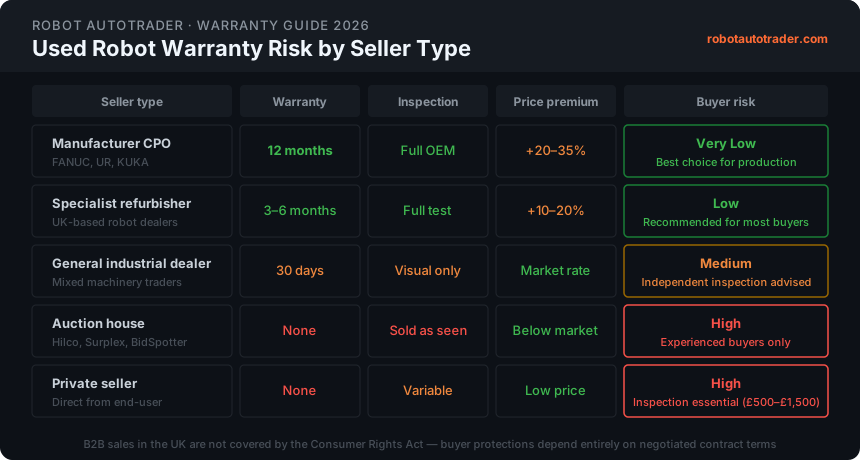
The Five Types of Used Robot Seller and What Warranty Each Offers
The warranty you receive, or do not receive, is determined almost entirely by who you buy from. There are five distinct seller categories in the UK used robot market, each carrying a different risk profile.
1. UK Robot Refurbishers
This is the highest-quality option available to used robot buyers. UK robot refurbishers are specialist businesses that purchase used robots, put them through full mechanical and electrical inspection, replace worn components, update software to current versions, and resell with a defined warranty period.
A reputable UK refurbisher will typically offer 3 to 6 months warranty covering:
- Mechanical failures discovered during normal operation
- Controller failures and teach pendant defects
- Joint and gearbox issues not attributable to operator error
- Electrical faults in the robot arm or control cabinet
What that warranty will not cover: programming errors, damage from improper installation, consumable items (batteries, grease, filters), and failures caused by operating outside the specified payload or reach envelope.
The premium over auction pricing is real, typically 15 to 30%. For most buyers, it is justified by the warranty, the documentation provided, and the ability to pick up the phone and speak to someone when something goes wrong.
UK-based refurbishers with established reputations include Robosource, PPM Technologies, and Fanuc UK's certified resale programme. Smaller regional specialists exist in manufacturing hubs such as the West Midlands and the North East.
2. Business Disposal and Factory Closures
When a manufacturer closes a production line or a business enters administration, its robots go onto the market. These units are sometimes sold direct by the business or through a machinery clearance company acting on behalf of the business or its administrators.
The quality and warranty provision here is variable. Some businesses will have maintained their robots meticulously and will provide service records. Others will have run them hard with minimal maintenance and will offer no documentation whatsoever.
What you typically receive: evidence the robot was operational at point of decommission, sometimes a short "tested and working" period of 30 to 60 days, and occasionally full service records if the business kept them properly.
What you do not receive: any meaningful warranty, inspection documentation, or software update confirmation.
These purchases sit in a middle-risk category. They can represent genuine value if you are buying a robot with a traceable, documented history from a business that maintained it well. They require more due diligence than buying from a refurbisher, and they warrant commissioning an independent pre-purchase inspection in most cases.
3. Industrial Auction Houses
Platforms including Surplex, Machineseeker Auctions, and Hilco Industrial regularly list used industrial robots in UK and European auction events. The robots are sold as-seen, no warranty, no returns.
This is the buyer-beware category. You may be buying a robot with ten years of service life remaining that runs perfectly. You may be buying one with a cracked housing, outdated software, and a controller that needs complete replacement. Without an inspection, you cannot tell the difference.
Auctions are appropriate for experienced buyers who can inspect items in person before bidding, have engineers capable of assessing robot condition, and have budget allocated for potential repair costs. They are not appropriate for first-time buyers or businesses without in-house robotics expertise.
The pricing can be genuinely attractive. A KUKA KR6 R700 in working condition has sold at Surplex for £2,500 to £4,000, against a refurbished resale value of £6,000 to £8,000. The gap exists because the risk is real.
4. International Dealers
European and Asian dealers frequently list robots available for export to the UK. German, Dutch, and Czech dealers are the most active, with Chinese dealers increasingly visible at the lower end of the market.
The practical problem for UK buyers is that any warranty offered by an international dealer has limited enforceability from a UK jurisdiction. Claiming against a German dealer for a fault that appears two months after delivery requires a dispute resolution process most buyers are not equipped to pursue. Shipping costs to return a defective robot for repair or replacement are prohibitive.
International purchasing can make sense when the robot is exceptionally well-priced and you have the technical capacity to assess it independently, or when the dealer has a UK service partner who can backstop warranty claims. In the absence of either condition, the apparent saving typically does not compensate for the absence of practical recourse.
5. Private Sales
Private sales, typically between businesses via platforms including this one, carry no warranty by default. The robot is sold as-seen unless you negotiate specific terms into the purchase contract.
This is not necessarily a reason to avoid private sales. A robot with full service history, sold by a business upgrading to newer equipment, can represent excellent value. The key is understanding that any protection you have comes from the contract you negotiate, not from any default warranty obligation.
What Good Warranty Language Actually Looks Like
Many used robot warranties contain language that sounds reassuring but provides limited practical protection. Here is what a well-written warranty clause should specify:
Coverage scope: Exactly which components and failure modes are covered. "Mechanical and electrical faults discovered during normal operation" is a reasonable summary, but the contract should exclude wear items explicitly (batteries, grease, seals, brake pads) to avoid disputes.
Duration: The start date should be delivery to your site, not dispatch from the seller. A 3-month warranty that starts ticking on the day the robot leaves a warehouse in Birmingham adds little if installation takes six weeks.
Labour: Does the warranty cover engineer call-out and labour costs, or parts only? Parts-only coverage on a KUKA KR QUANTEC can leave you facing a £3,000 to £5,000 labour bill even when the defective part is supplied free of charge.
Return or on-site service: Will the seller dispatch an engineer to your site, or do you need to return the robot? Returning a 600kg six-axis arm is not a trivial operation.
Exclusions: A transparent seller will list exclusions clearly. Be cautious of warranty language that excludes "any fault arising from use" without defining what constitutes appropriate use.
The Pre-Purchase Inspection Option
For any used robot purchase without a manufacturer or refurbisher warranty, a pre-purchase inspection from a certified engineer is the single most cost-effective protection available.
A thorough inspection from a FANUC, ABB, KUKA, or Universal Robots certified engineer will typically cover:
- Joint condition assessment on all axes, including manual rotation with power off to detect wear
- Backlash measurement on all gearboxes
- Controller board diagnostic, including error log review (error history reveals a great deal about how a robot has been operated)
- Teach pendant function test
- Cable and harness inspection for wear and damage
- Software version check and confirmation of licence status
- Payload and reach test cycle at rated load
- Calibration check
The engineer produces a written report confirming findings. This document serves two purposes: it tells you whether to proceed with the purchase, and it establishes a baseline condition record that protects you if faults emerge shortly after delivery.
Cost: £500 to £1,500 depending on robot model, location, and inspection depth. Some refurbishers will conduct the inspection as part of a conditional purchase arrangement. Independent inspection companies such as RARUK Automation and regional KUKA or FANUC service partners offer standalone inspection services.
For any robot priced above £10,000, the inspection cost is comfortably justified. A single joint replacement on a Universal Robots arm, which an inspection might flag as imminent, costs £2,000 to £5,000.
Manufacturer Certified Pre-Owned Programmes
The three largest industrial robot manufacturers with active UK certified pre-owned programmes in 2026 are FANUC, Universal Robots, and KUKA. Each offers a meaningfully different proposition.
FANUC Certified Pre-Owned
FANUC's UK certified pre-owned programme is operated through FANUC UK's service division and authorised service partners. Units go through a full FANUC-standard inspection covering mechanical, electrical, and software condition. Software is updated to current versions. A 12-month FANUC warranty is applied, with FANUC UK as the warranty counterparty.
The premium over open market pricing is typically 25 to 40%. For buyers who need manufacturer-grade warranty certainty, this premium is reasonable. For buyers with in-house technical expertise who can assess robot condition independently, the maths may favour a well-inspected open-market purchase instead.
Universal Robots Certified Pre-Owned
UR's certified pre-owned programme is delivered through its UK distribution and service network. UR cobots are among the most straightforward to inspect and maintain in the industry, which keeps certification costs relatively contained. The programme includes software update to current PolyScope version, joint replacement where required, and 12 months of UR warranty.
UR cobots depreciate more slowly than traditional industrial robots, which means the gap between certified pre-owned pricing and open market used pricing is smaller. Expect a 15 to 25% premium for the certification. Given UR's strong service network in the UK, this is an attractive option for buyers who want maximum ongoing support.
KUKA Certified Refurbishment
KUKA's certified programme is more variable in availability and scope than FANUC or UR equivalents, partly reflecting the wider range of KUKA robot families and payload classes. KUKA KR AGILUS and KR CYBERTECH models are the most commonly available through the programme. The warranty period varies between 6 and 12 months depending on robot age and inspection outcome.
For KUKA KR QUANTEC and larger payload models, open-market purchase with independent inspection and contract protection is often the more practical route, as certified pre-owned availability for these models is limited.
The UK Legal Position: Why Your Contract Is Everything
This point deserves emphasis. The Consumer Rights Act 2015, which provides the implied terms most people associate with UK warranty protection (goods must be of satisfactory quality, fit for purpose, and as described), applies to consumer purchases. Most robot buyers in the UK are businesses purchasing for commercial use.
In a B2B transaction, the default position under the Sale of Goods Act 1979 still implies some quality obligations, but these are far more limited and are routinely excluded or modified by contract terms. A seller who includes a properly drafted exclusion clause in the purchase agreement can significantly limit their liability for defects discovered after sale.
This means the specific terms of your purchase contract are the primary source of any protection you have. It is worth having a solicitor or commercial contracts specialist review the purchase agreement for any robot transaction above £25,000.
Protecting Yourself When Buying Without Warranty
If you are proceeding with a purchase that carries no warranty, whether from auction, private sale, or business disposal, the following contractual provisions give you meaningful protection:
Tested condition clause: The seller confirms in writing that the robot was operational at the point of sale, confirming the specific software version and confirming no known faults or outstanding error codes.
Acceptance testing period: A period of 5 to 10 business days following delivery during which you can conduct power-on tests and reject the unit if it fails to meet agreed performance criteria. The acceptance criteria should be specified: successful completion of a defined test cycle, no error codes on boot, specified axes moving within rated speed and torque parameters.
30-day fault reporting window: A clause allowing you to report latent faults discovered within 30 days of delivery, with a defined remedy process. This does not need to be a full warranty, but it gives you recourse if a significant defect was present but not apparent at the time of inspection.
Documentation list: A schedule attached to the contract listing every item included in the sale: teach pendant, cables, controller cabinet, software licences, tooling, and any documentation. This prevents post-sale disputes about what was and was not part of the purchase.
Third-Party Robot Insurance
Third-party machinery insurance covering mechanical breakdown and electrical failure is available for industrial robots in the UK. Specialist providers including Markel, Zurich, and Hiscox offer relevant policies through industrial machinery insurance brokers.
Coverage typically includes sudden and unforeseen mechanical breakdown, electrical failure, and in some policies accidental damage caused during normal operation. Premiums for a used robot insured at £15,000 typically run £250 to £500 per year depending on age, application, and robot model.
Insurance is not a substitute for a pre-purchase inspection or a well-drafted purchase contract. It is, however, a sensible ongoing protection measure after warranty expiry, particularly for robots in continuous production use where downtime costs are significant.
The True Cost of Buying Without Warranty: A Framework
When pricing an offer on an unwarranted robot, the following repair cost benchmarks should inform how much discount you require relative to a warranted alternative:
Universal Robots UR5e / UR10e: Joint replacement £2,000 to £5,000 per joint. Controller failure £1,500 to £3,500. Teach pendant replacement £800 to £1,500. Total worst-case unplanned repair exposure in year one: £6,000 to £10,000.
KUKA KR AGILUS / KR CYBERTECH: Gearbox replacement £2,500 to £6,000 per axis. Controller board failures £2,000 to £5,000. In-warranty rate versus out-of-warranty call-out differential: approximately £800 to £1,200 per visit.
KUKA KR QUANTEC (high payload): Gearbox replacement £8,000 to £20,000 for primary axes. Full controller replacement £12,000 to £25,000. These figures represent a meaningful proportion of the robot's used market value.
FANUC M-10iA / M-20iA: Joint seal and gearbox failures £1,500 to £4,000 per axis. Controller repair or replacement £3,000 to £7,000. FANUC's parts availability in the UK is good, which constrains labour costs relative to less-supported brands.
A simple framework: if the discount offered on an unwarranted unit versus a comparable warranted alternative is less than 20%, the financial case for accepting the warranty risk is marginal. Below 15% discount, the warranted purchase is almost always the better decision once expected repair probability is factored in.
Summary
Warranty protection in the UK used robot market exists on a spectrum, from the full manufacturer-backed 12-month coverage of a certified pre-owned programme to the complete absence of recourse in a no-reserve auction purchase. The most important things to establish before any used robot purchase are: who you are buying from, what their warranty actually covers in writing, and what contractual protections you can negotiate into the transaction.
For purchases above £10,000 without a warranty, budget £500 to £1,500 for a pre-purchase inspection. For purchases above £25,000 on any terms, have the contract reviewed. The cost of either is negligible relative to the cost of a major fault in a robot you have no recourse on.
The UK used robot market offers genuine value. But that value is only realised when the purchase is protected.
Frequently Asked Questions
Do used robots come with a warranty in the UK?
It depends entirely on who you buy from. UK robot refurbishers typically offer 3 to 6 months warranty covering mechanical faults and controller failures. Business disposal sales and auction purchases carry little or no warranty. Private sales carry none at all. The seller type is the single biggest determinant of what protection you receive.
Does the Consumer Rights Act protect me when buying a used robot in the UK?
No, not if you are buying as a business. The Consumer Rights Act 2015 applies to consumer purchases only. Most robot buyers in the UK are businesses purchasing for commercial use, which means the statutory protections that apply to retail consumers do not apply. Contract terms negotiated at the point of sale are your only protection.
What does a used robot warranty typically cover?
A well-written used robot warranty from a UK refurbisher will cover mechanical faults discovered during normal operation, controller and teach pendant failures, and joint or gearbox issues that appear within the warranty period. It will not cover programming errors, damage from improper installation, consumable items such as batteries and grease, or faults caused by inappropriate payload or operating conditions.
How much does a pre-purchase inspection cost for a used robot in the UK?
A certified inspection from a manufacturer-trained engineer typically costs between £500 and £1,500 depending on the robot model and how thorough the inspection needs to be. For any unwarranted purchase over £10,000, this cost is almost always justified given the repair bills it can prevent.
What is a manufacturer certified pre-owned robot programme?
Several manufacturers, including FANUC, Universal Robots, and KUKA, offer certified pre-owned programmes. These involve full factory-standard inspections, software updates, and a new manufacturer warranty, typically 12 months. The premium over the open used market is usually 20 to 35%, but the warranty quality and peace of mind is considerably higher than anything offered by third-party sellers.
How much can robot repairs cost without a warranty?
Repair costs vary significantly by model. A joint replacement on a Universal Robots arm runs £2,000 to £5,000 in parts and labour. A gearbox replacement on a KUKA KR QUANTEC can cost £8,000 to £20,000. Controller board failures on older FANUC units can run £3,000 to £7,000. These figures illustrate why the purchase discount on an unwarranted robot must be substantial to make financial sense.
Can I get insurance for a used industrial robot in the UK?
Yes. Third-party robot and machinery insurance is available in the UK, covering mechanical breakdown, electrical failure, and in some policies accidental damage. Specialist industrial machinery insurers such as Markel and Zurich offer relevant products. Premiums depend on robot age, value, and application but are typically 1.5 to 3.5% of insured value per year. Insurance is not a substitute for a good pre-purchase inspection, but it provides ongoing protection after a warranty expires.
What should a used robot purchase contract include if there is no warranty?
At minimum, a used robot purchase contract without warranty should include a tested condition clause confirming the robot was operational at point of sale, a 30-day fault reporting window allowing you to claim against hidden defects discovered immediately after delivery, an acceptance testing period of 5 to 10 business days during which you can reject the unit if it fails agreed tests, and a clear statement of what software, tooling, and documentation is included in the sale.