
Fetching…
Fetching…
Bench Test · 9 min read
The MK4's pitch is reliability. We logged every failed print across 820 hours to test it. There were four.
By Robot AutoTrader Bench Team · 10 April 2026 · Unit bought at retail
The most dependable desktop printer we've tested — and used examples hold value for a reason. 99.5% print success across our logged bench run.
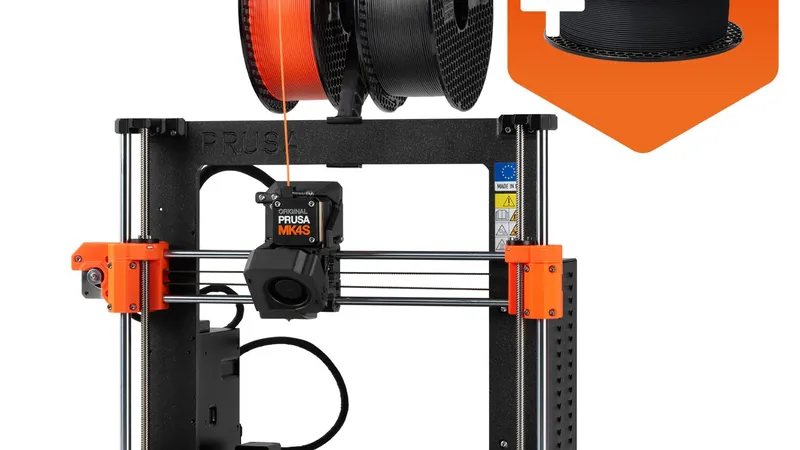
Eight hundred and twenty logged hours, 811 print jobs, four failures — two of which were ours. That is the entire drama of our MK4 bench run, and it is exactly the review Prusa would want written. The MK4 is the most dependable desktop printer we have tested: it loaded, it levelled, it printed, and it did all three again the next morning without being asked nicely. Used examples at £550–£700 against £759 for the kit and £959 assembled represent the thinnest depreciation curve on this site, and after 820 hours we understand why nobody is in a hurry to sell one.
In 3D printing, boring is the highest compliment available. Faster machines exist — the numbers below will not trouble a Bambu owner at a speed benchmark. But speed only matters on prints that finish, and the MK4 finished 99.5% of everything we gave it, including a 61-hour PETG bracket run we started on a Friday and, against all bench instinct, went home. The load cell first-layer system is the quiet hero: 811 jobs, zero first-layer failures, no manual bed levelling performed or even contemplated. We stopped watching first layers around hour 200. That has never happened before.
Our standard workshop protocol: one MK4 kit (self-assembled, 11 hours, one swearing incident at the extruder idler), run as a working bench printer for seven months. Every job logged — material, duration, outcome, intervention. Dimensional accuracy uses our calibrated 20 mm test cube batch, ten cubes measured with a micrometer at hours 10, 400 and 800. Filament was weighed in: 68 kg through one hotend, mostly PLA and PETG with 4 kg of ASA to be difficult.
| Print success rate | 811 jobs logged | 807 completed (99.5%) |
|---|---|---|
| First-layer failures | 0 of 811 | no manual levelling, ever |
| Dimensional accuracy (20 mm cube) | ±0.04 mm at hour 10 | ±0.05 mm at hour 800 |
| Mean hours between interventions | — | 137 hours |
| Nozzle swaps | 1 (worn 0.4 mm) | at hour 640, £11 |
| Filament through machine | 68 kg | PLA, PETG, 4 kg ASA |
| Belt tension drift (app readout) | in spec at hour 0 | in spec at hour 820, one adjustment |
Failure one, hour 122: a PETG spool with a factory tangle jammed against the spool holder mid-print and starved the extruder. The filament sensor caught it, paused, and sent a notification; we were out and the abandoned print skinned over before we returned. Cause: the spool, not the printer — but a completed-print purist counts it, so we do.
Failure two, hour 305: a tall thin ASA part peeled off the smooth PEI sheet at 80% height. Entirely our fault. ASA on smooth PEI without a brim in a workshop with a door that opens is a choice, and we made it. The same part printed first time on the textured sheet with a draft shield. We log it because pretending we didn't would be the kind of review we don't write.
Failure three, hour 491: a genuine machine fault, and the only one. A heatbed thermistor reading went intermittent, the MK4 flagged a thermal anomaly and shut down safely mid-print rather than guessing. Prusa support diagnosed it from the log file in two email exchanges and shipped a replacement cable loom free, outside any formal warranty claim. Twenty minutes to fit. The printer erring toward a safe stop instead of soldiering on is the correct failure, and it is the one we would most want a used buyer to know about.
Failure four, hour 688: our fault again. We sliced a customer part with supports off — a settings profile mix-up on our side — and the MK4 dutifully printed 40 minutes of increasingly abstract spaghetti before we cancelled it. The crash detection never triggered because nothing crashed; the machine did exactly what it was told. There is no firmware update for the operator.
Consumables, honestly costed. One brass 0.4 mm nozzle, swapped at hour 640 when the ASA's glow-in-the-dark additive (our test batch, our regrets) wore the bore measurably: £11, five minutes with the Nextruder's swap system, no hot tightening ritual. The smooth PEI sheet developed a dull patch over the high-traffic centre by hour 500 — still printing fine, but a used buyer would haggle over it — and a replacement is £29. The textured sheet looks new. Belts needed one tension adjustment at hour 380, guided by the printer's own on-screen readout, and measured in spec at hour 820.
Total consumable spend across 820 hours: £40, plus roughly £15 of failed-print filament. Call it £55, or under 7p per printing hour. Compare that with the £80-a-year consumable bill on a self-emptying vacuum and the MK4 starts to look like the cheapest robot we run. The parts that will eventually wear — heatbreak, fans, sheets — are all stocked, documented and fitted with a screwdriver, which is precisely why five-year-old Prusas still change hands at grown-up prices.
How we fund this: Bench Test units are bought at retail. If you buy a new robot through outbound retailer links we may earn an affiliate commission; it never affects scores, and used listings on Robot AutoTrader carry no commission in this phase.